
High blue, Day
~5000 K
Circadian-friendly lighting that follows the falling sun, a natural spectrum through the day to help you focus, and no blue light at night to help you fall asleep.
Try before you buy, or rent with Bulbsharing®.


Ordinary bulbs pour out blue light, the same wavelength the midday sun uses to tell your brain it’s daytime. Keep that light on into the night and your body never gets the signal to wind down. For three million years, the spectrum told the time. Your home should too.


At noon, the sun’s light punches straight down through ~20 km of air. At sunset it skims sideways through hundreds of kilometres, and all that air scatters the blue away first. Drag the sun around the Earth, then let the fire and the full moon take over the night the way they did for millions of years.
Sunlight is a clock you can see: blue overhead at noon, none left by nightfall. That arc is the signal your body evolved expecting.
Flip the cord switch: a vitae bulb always wakes on its warmest, blue-free setting. Add a classic bulb, the sun or a fire from the shelf and compare. Watch the left of each spectrum, the band that tells your body it's daytime.
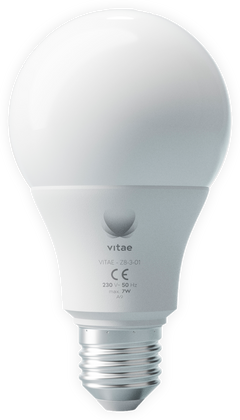
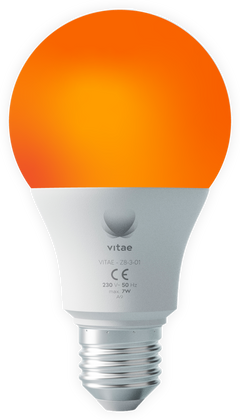
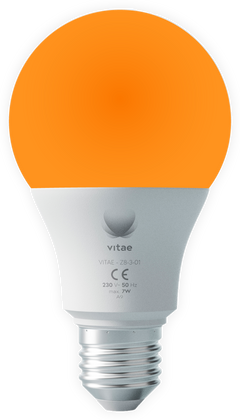
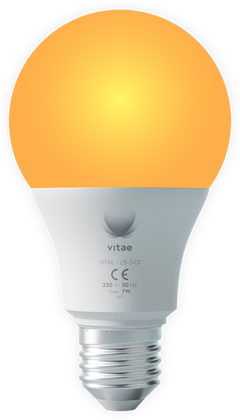
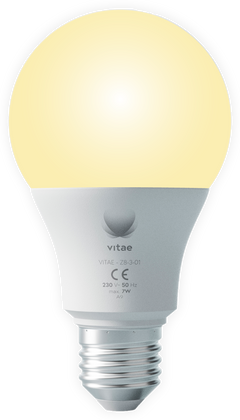
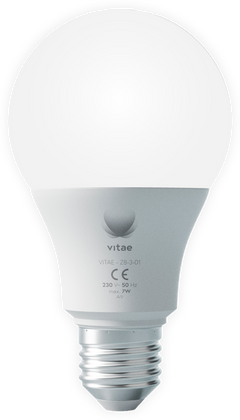
vitae from the datasheet; classic bulbs and nature are typical values. Bar height follows brightness. Day signal = MDER (noon sun 1.0, candle 0.2).
Two lights can look equally “white” and be worlds apart underneath: at 10 p.m. an ordinary bulb is still saying noon. One switch, and vitae keeps time with you.
No apps. No Wi-Fi. No setup.
Just simple, intelligent light that follows the day.

A soft amber glow that lets melatonin rise and prepares your body for deep, uninterrupted sleep.

Warm, comfortable light for dinner, the sofa and winding down after a busy day.

Bright, daylight-like light that lifts productivity and keeps you alert through the day.
Why night first? vitae never surprises you with a bright mode, the night-safe setting always comes first.
Most people feel the difference within a few nights. The idea is simple: take away the thing disrupting your sleep, and sleep gets better.
Without blue light suppressing melatonin, your body gets sleepy at the right time.
Deeper, more restorative sleep means you wake before the alarm and actually feel good.
Proper circadian alignment gives you even energy, without the afternoon crash.
Better sleep means better memory, judgement and decision-making.

“To deliver the best, we test what we make, keep up with the science, and occasionally lose a little sleep so you don’t have to.”
Two workhorses you can rent or buy, and three small upgrades that finish the job. Start with one, your eyes adjust faster than you’d think.

The core of the system. One switch cycles night → evening → day. Four room models, plus two fixed-temperature bulbs for honest, simple light.

A long, even wash for desks, kitchens and studios. The Pro tracks the full day; the 4000 K is a fixed, flicker-free workhorse.

For the screens you can’t turn warm. Cut blue and green at the eye, anywhere.

Red & orange transparent cut-outs for the blue-green glow of thermostats, routers and standby LEDs.

No fitting, no lamp to buy. Clip it anywhere, screw in a vitae bulb, done. The easiest way to start.

There are cheaper orange bulbs, there always will be. What you can’t buy cheaply is an honest spectrum, a flicker-free build, and a five-year promise standing behind it. This is the one people keep, recommend, and quietly show off.
Night mode doesn’t dim blue light, it removes it. Reaching a melanopic ratio of 0.016 takes specific phosphors and premium LED chips that cost many times an ordinary “warm white” diode. That cost is the whole point: it’s the difference between light that merely looks warm and light your body actually reads as night.

Designed and built in the Czech Republic since 2014. The original, and still the one worth owning, not the cheap remake.
Twelve years tuning phosphors and chips to remove blue light, not merely dim it, and patenting the three-mode design others now copy.
Constant-current driven, with no 100 Hz strobe for your eyes to fight. Flicker-free light that people keep and recommend.
Rated for 25,000+ hours and backed for five years. We promise that without flinching, because of how they’re built, not how cheaply.
Most bulbs marketed as “warm” still emit real blue light, just less than cool white. vitae’s Night mode has an MDER (Melanopic Daylight Efficacy Ratio) of just 0.016; for comparison, firelight is around 0.2. We’ve eliminated blue light, not merely reduced it.
Just turn it off and back on. Each flip cycles to the next mode: night → evening → day → night. No apps, no Wi-Fi, no setup. The bulb resets after about 15 seconds off, so the next mode is always the night-safe one, no accidental bright light at 3 a.m.
vitae uses a standard E27 screw socket, the most common bulb base worldwide. If your current bulb screws in, vitae will fit. E26 fixtures are compatible too.
Each bulb is rated for 25,000+ hours and carries a 5-year warranty. At typical use of five hours a day, that’s well over a decade.
The bulb changes your environment, everyone in the room benefits. The glasses are personal and portable, ideal for hotels, commuting, or anywhere you can’t control the lighting. Many people use both.
Most people report falling asleep more easily within the first few nights. The fuller benefits, steadier energy, mood and focus, usually settle in over one to two weeks of consistent use.